
Odour Control & Deodorisation
Dry Fogging Treatment in Liverpool & Merseyside
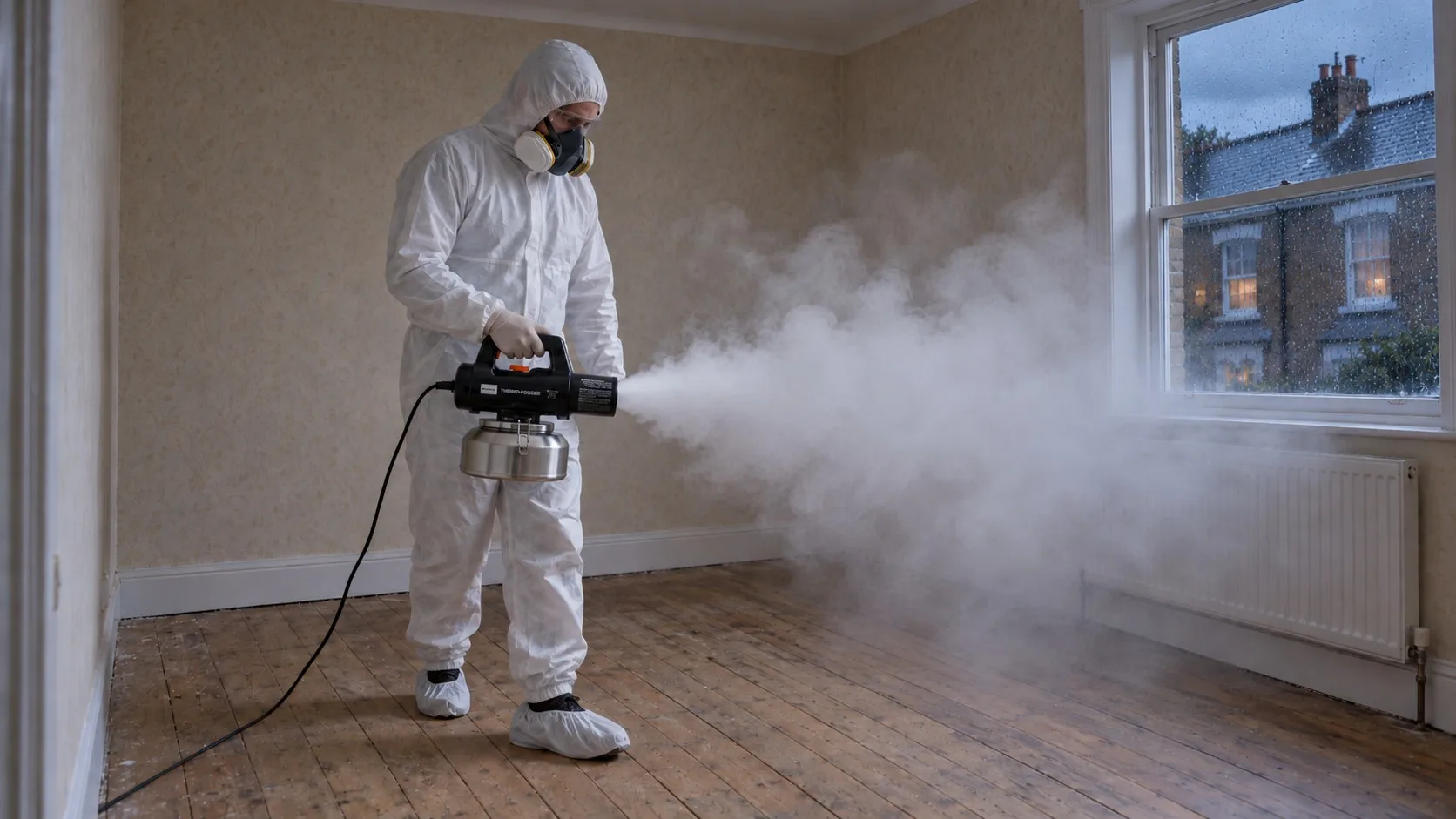
Dry fogging produces an ultra-fine vapour that penetrates deeply into porous materials, cavities and voids — reaching areas that wet fogging and manual cleaning cannot access. Used for persistent odour and embedded contamination.
What Dry Fogging Is
Dry fogging uses specialist equipment to generate an extremely fine vapour — with particles significantly smaller than those produced by conventional wet fogging machines. At this particle size, the vapour behaves more like a gas than a mist, allowing it to migrate through tiny gaps, into porous materials and within structural voids that a liquid spray or heavier droplet cannot reach.
The term "dry" refers to the fact that the particles are small enough not to leave significant surface moisture — the treatment does not wet surfaces in the way that spray application or wet fogging does. This makes it appropriate for use in spaces where moisture could cause additional damage, such as properties with electrical fittings, sensitive surfaces or existing damp problems.
The solutions used are selected for the specific situation — enzymatic agents for organic odour, neutralising compounds for chemical odour, or disinfectants where bacterial contamination within materials is the concern.
Where Dry Fogging Reaches
The advantage of dry fogging over other methods is its ability to penetrate:
- —Subfloor voids and underfloor cavities where biological contamination has settled
- —Wall cavities in timber-framed or cavity-wall construction
- —Porous materials including timber, brick, plasterboard and concrete block
- —Behind units, inside fitted furniture and within built-in cabinetry
- —Ceiling voids and loft spaces accessible via gaps in construction
- —HVAC ducts and ventilation channels where odour recirculates
This penetration makes dry fogging particularly effective where odour persists following surface cleaning — a sign that the source compound has migrated beyond what surface treatment alone can reach.
When Dry Fogging Is Used
- —Persistent decomposition odour following cleaning — where residual compounds remain within structural materials
- —Severe animal urine contamination that has saturated into subfloor materials
- —Smoke odour that has penetrated walls and ceiling voids
- —Mould-related odour where spores and volatile compounds are embedded in porous surfaces
- —Properties where surface cleaning has not resolved the odour problem
- —Follow-up treatment after wet fogging, where deeper penetration is needed
How It Compares to Other Methods
Wet fogging treats surfaces and airborne compounds effectively and is well suited to broad coverage of a room or property. Dry fogging complements this by reaching into the materials themselves. The two methods are often used in sequence.
Ozone treatment works by oxidising odour compounds chemically and is useful for severe or entrenched odour, but requires the property to be fully vacated for longer periods and requires careful management. Dry fogging can achieve similar results in some situations with a shorter dwell requirement.
We advise on which combination of methods is appropriate after assessing the property. In many cases, the most effective approach is a combination — surface cleaning, followed by dry fogging into materials, and ozone where necessary.
Getting a Quote
Dry fogging can be carried out as a standalone treatment or as part of a wider programme of odour control and specialist cleaning. Contact us to discuss your situation and we will advise on the appropriate approach.