
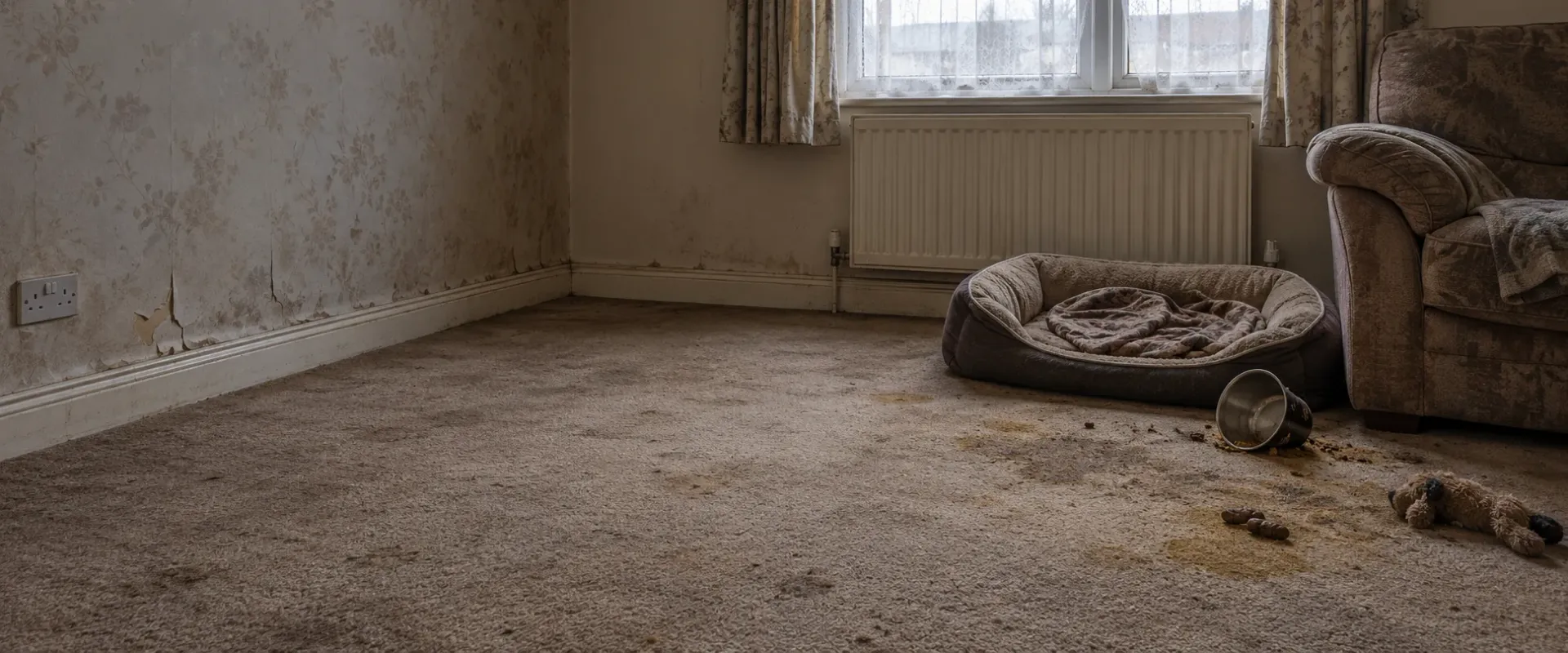
When Animal Contamination Becomes a Specialist Task
Animal contamination can range from isolated soiling to long-term, widespread contamination throughout a property. What begins as a manageable situation can become significantly more difficult to address after weeks or months of repeated fouling — particularly once urine and faecal matter have absorbed deeply into floor coverings, furniture, timber and walls.
Possible issues that bring properties to us include:
We approach every assignment without judgement. Animal contamination can occur in many circumstances, and our role is practical — to assess what has happened and carry out a clear, structured programme of work.
Why Animal Urine Can Be Difficult to Remove
Repeated urine contamination does not stay on the surface. It soaks into porous materials over time — sometimes penetrating through carpet, through underlay and into the floor structure beneath. Surface cleaning alone may not resolve the problem once urine has absorbed at depth, because the odour source remains even after the visible surface has been treated.
Materials that can be affected include:
Persistent odour typically means the contamination source is still present in the material. Fragrance and masking products may temporarily reduce the smell, but they do not address the underlying cause. Effective treatment begins with locating and properly dealing with the contaminated material.
Cat Urine
Cat urine can produce a particularly persistent odour, especially where a cat has repeatedly marked the same areas over a prolonged period. Common affected areas include corners, doorways, skirting boards, stairwells, hallways, carpets and the bases of furniture.
Successful treatment depends on accurately locating the contaminated areas — sometimes using specialist equipment — and treating or removing the affected material. Where spraying has penetrated skirting boards or walls, these surfaces may also require cleaning or treatment.
Fragrance or masking products are not a reliable long-term solution for established cat urine contamination. The source needs to be addressed first.
Dog Contamination
Dog-related contamination may involve urine, faeces and repeated soiling across multiple areas of the property. Heavily contaminated materials may have absorbed waste into the floor structure beneath, and some items may require removal rather than cleaning.
Animal Faeces
Accumulated animal faeces may require more than standard domestic cleaning, particularly where soiling has occurred repeatedly over time, across multiple rooms, or in confined areas. The work involved may include:
- Removal of accumulated waste
- Removal of heavily soiled carpets and underlay
- Cleaning of hard surfaces
- Sanitisation where appropriate
- Furniture removal where required
- Odour-source treatment
Carpets & Underlay
Carpets and underlay can absorb repeated urine contamination progressively. Where saturation has been significant, the underlay may hold most of the contamination even after the carpet surface appears clean — which is why odour often persists after surface cleaning alone.
Depending on the severity, the options may include specialist cleaning, localised treatment, or removal of both carpet and underlay to expose and assess the flooring beneath. In some cases, replacing heavily contaminated floor coverings is more effective than repeatedly attempting surface treatment.
We will advise clearly at the survey stage on whether treatment or removal is the more appropriate approach for the property.
Floorboards & Porous Flooring
Where carpet and underlay have been heavily saturated over a long period, contamination can penetrate into the subfloor material — timber floorboards, chipboard and other porous materials. These may require cleaning and specialist treatment, and in more severe cases, partial removal.
Where sealing or replacement of flooring is required after remediation, this is typically a separate trade — a flooring contractor or specialist. We will advise where this may apply, so that appropriate arrangements can be made.
Walls, Skirting Boards & Fixtures
Repeated marking or spraying — particularly by cats — can affect skirting boards, door frames, lower wall surfaces, kitchen units and furniture. Depending on the material and how long the contamination has been present, affected areas may require cleaning, specialist treatment or, in more severe cases, removal.
Soft Furnishings
Some porous items are not economically recoverable after prolonged contamination. Examples include mattresses, sofas, armchairs, bedding, curtains, rugs and cushions. Whether an item is worth treating depends on several factors:
We will not promise that every item can be restored. Where removal is the practical choice, this will be included in the written quotation.
Odour Removal
Pet odour is usually source-based — it comes from contaminated material that is still present in the property. Deodorisation products applied without addressing the source may temporarily mask the smell, but the odour typically returns. The correct approach is to deal with the source first.
Preferred sequence for effective odour treatment:
- 1Locate the contaminated areas accurately
- 2Remove heavily affected waste or furnishings
- 3Physically clean affected surfaces
- 4Treat contaminated porous materials where appropriate
- 5Sanitise where required
- 6Assess remaining odour once sources are addressed
- 7Apply specialist deodorisation if residual odour remains
Potential additional deodorisation methods:
Wet fogging
A fine mist treatment applied to affected surfaces and airspace to neutralise odour molecules.
Dry fogging
A dry vapour treatment suited to surfaces where moisture is not appropriate.
Ozone treatment
Used in appropriate cases where odour has penetrated porous materials; requires full exclusion of people and pets during treatment.
These methods supplement physical cleaning — they are not a substitute for it. For further detail, see our Odour Control page.
Flies, Insects & Pest Activity
Significant animal fouling may attract flies and insects, particularly in warmer conditions. Merseyside House Clearance can deal with the contaminated materials and environmental cleanup — removing the source of attraction and cleaning affected surfaces.
Where an active pest infestation is present, separate pest-control treatment may also be required. We do not provide pest eradication services, and would advise on this if it appears relevant during the survey.
Animal Contamination With Hoarding
Animal contamination sometimes occurs alongside significant clutter, hoarding or restricted access. In these situations the property may also have hidden animal waste in less accessible areas, contaminated possessions, food waste, or pest activity — all of which affect how the work needs to be planned.
A combined clearance and specialist-cleaning approach is often needed. Related services:
Ozone Treatment — Important Safety Information
Where ozone treatment is used as part of an odour-control programme, all people, pets and other occupants must be excluded from the treatment area while the ozone generator is operating. Re-entry should only take place after the appropriate treatment and ventilation period.
Suitable arrangements for pets during treatment are made by the owner, family or responsible professional. Ozone is not a substitute for physical cleaning — it is used after contaminated materials have been removed and surfaces cleaned, where residual odour remains.
Our Process
Initial Enquiry
Discuss the type, extent and history of contamination — by phone or in writing, confidentially.
Photographs or Survey
Assess affected rooms, flooring, furnishings and odour. Photographs may help initially; a physical survey may be required for more extensive cases.
Written Quotation
A clear written explanation of what will be removed, cleaned and treated before any work begins.
Clearance
Remove unwanted or heavily contaminated material — carpets, furniture, bedding, accumulated waste — as agreed.
Physical Cleaning
Clean all affected surfaces, removing visible residues methodically and thoroughly.
Sanitisation
Apply appropriate products and procedures to affected surfaces where required.
Odour-Source Treatment
Address contaminated materials or surfaces that are the physical source of persistent odour.
Specialist Deodorisation
Where residual odour remains, additional methods such as wet fogging, dry fogging or ozone treatment may be used where appropriate.
Completion
Agreed photographs or documentation provided on completion where applicable.
Landlords & Housing Providers
Animal contamination is a common issue discovered after a tenancy ends, during void inspections, or following a possession or clearance. We assist landlords, letting agents, housing associations and property managers with contaminated properties at all stages.
We do not offer decorating or structural repair services — where these are required after remediation, we will advise so that appropriate contractors can be arranged.
Working with Adult Social Care
Some animal-contamination cases involve vulnerable adults, self-neglect or hoarding. We work alongside Adult Social Care teams, housing officers and other professionals where appropriate.
Client dignity and confidentiality are priorities throughout. The scope of work is agreed with the appropriately authorised person — we do not make welfare or capacity decisions on behalf of the service user. Completion reporting and documentation can be provided where required.
How Much Does Animal Contamination Cleaning Cost?
There is no standard price because every property is different. The cost depends on:
We do not quote fixed prices for this type of work. Photographs help with an initial assessment; a physical survey is often needed for more extensive contamination. A clear written quotation is provided before any work begins — there is no obligation to proceed.
Confidentiality
We deal with all assignments discreetly. Property addresses, client details, photographs and personal circumstances are not used for publicity without appropriate permission.
See our Confidentiality & Client Data page for further information.
Service Areas
Based in Merseyside, Liverpool and the surrounding area is our primary territory. We regularly cover Wirral, Sefton, Knowsley, St Helens, Halton, Warrington and Cheshire, and also work across parts of Greater Manchester and the wider North West.
Liverpool
- City Centre
- North Liverpool
- South Liverpool
- West Derby
- Garston
- Wavertree
- Toxteth
- Aigburth
- Anfield
- Kensington
Wirral
- Birkenhead
- Wallasey
- Bebington
- Heswall
- Ellesmere Port
Sefton
- Bootle
- Crosby
- Southport
- Formby
- Maghull
Knowsley
- Kirkby
- Huyton
- Prescot
- Halewood
St Helens & Halton
- St Helens
- Newton-le-Willows
- Runcorn
- Widnes
Warrington & Cheshire
- Warrington
- Chester
- Northwich
Contact us to confirm availability for your specific location.
Frequently Asked Questions
Cat urine odour is best addressed by first locating and treating or removing the contaminated material — carpet, underlay, timber, skirting or furniture. Fragrance or masking agents are not an effective long-term solution. Once the source has been properly dealt with, additional deodorisation can be applied where any residual odour remains.
Yes. We deal with dog urine, faecal contamination and repeated soiling. The extent of the work depends on the severity and how long the contamination has been present. A survey or photographs will help us understand what's involved and prepare an accurate written quotation.
This depends on how deeply the carpet and underlay have been saturated. Where contamination has penetrated repeatedly over a long period, removal is often more effective than surface treatment. We will advise clearly during the survey stage.
Yes. Where carpets and underlay have been saturated for an extended period, urine can penetrate into the subfloor material beneath — including timber floorboards and chipboard. These may require cleaning, specialist treatment or, in more severe cases, partial removal.
Some furniture can be cleaned and treated; some cannot be economically recovered once urine or faecal contamination has deeply penetrated the material. We will give an honest assessment at the survey stage rather than make a promise that cannot be kept.
Yes. Mattresses that have been repeatedly soiled are usually beyond practical cleaning and are removed as part of the agreed scope of work.
Yes. Animal contamination sometimes occurs in heavily cluttered or hoarded properties. In these cases, a combined clearance and specialist-cleaning approach may be needed. We can assess both and agree a staged programme where appropriate.
During certain stages of cleaning, fogging or ozone treatment, it is necessary for pets not to be in the treatment area. For ozone treatment specifically, all people, pets and other occupants must leave during operation and for the appropriate ventilation period afterwards. Suitable arrangements for pets are made by the owner, family or responsible professional.
Ozone may be used as part of an odour-control programme where it is appropriate. It is not a substitute for physical cleaning — it is applied after contaminated materials have been removed and surfaces cleaned, where residual odour remains. All people, pets and occupants must be excluded during treatment and until proper ventilation has been completed.
Yes. We regularly assist landlords, letting agents, housing associations and property managers with animal-contaminated properties — including void properties, abandoned tenancies and post-clearance situations. Written quotations and completion documentation are provided where required.
There is no fixed price — cost depends on the number of affected rooms, severity, how long contamination has been present, flooring type, furniture involved, carpet removal, odour treatment and duration of work. Photographs or a physical survey help us prepare an accurate written quotation.
Need Help With Animal Contamination or Persistent Pet Odour?
Call us to discuss the property. We can arrange a survey and provide a clear written quotation before any work begins. There is no obligation to proceed.