
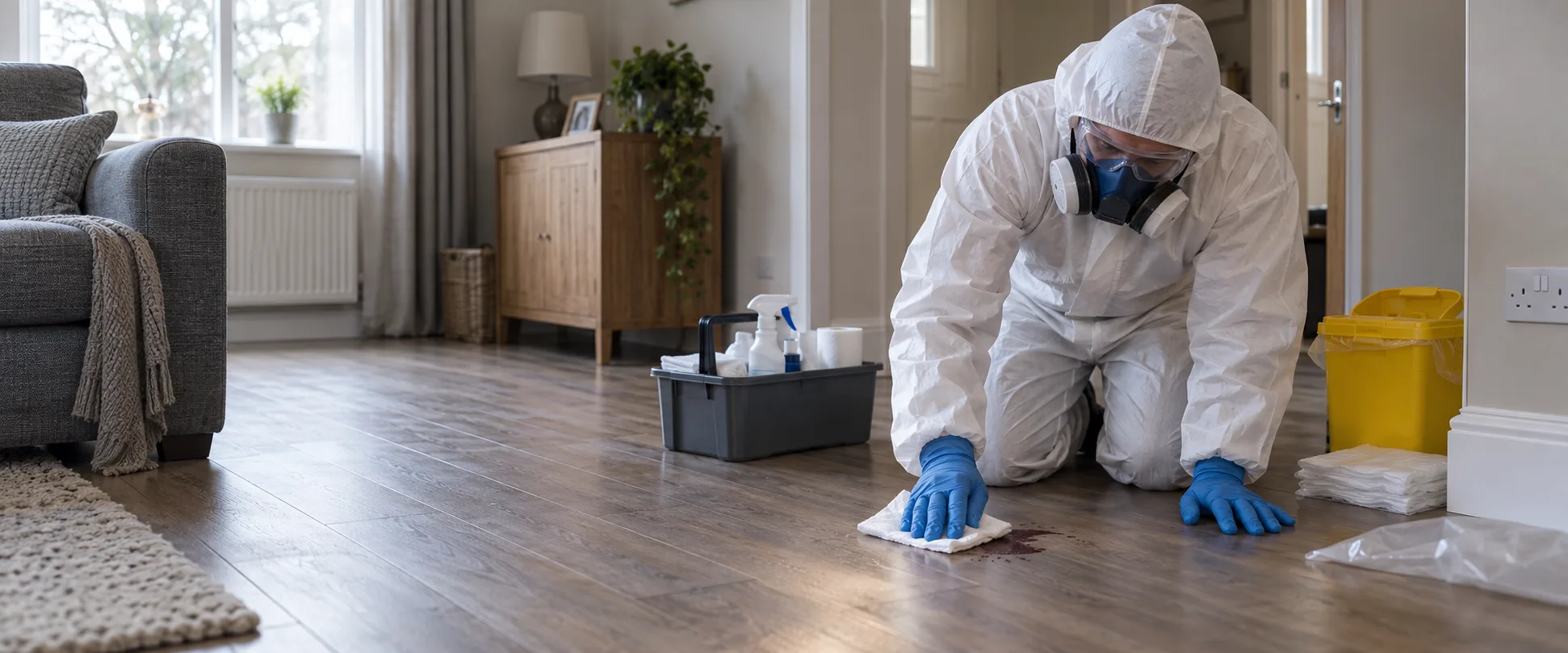
When Human Waste Contamination Occurs
Some properties become contaminated through urine, faeces, adult incontinence, commode waste, soiled bedding or heavily affected furnishings. This type of situation can arise in a wide range of circumstances and may involve any room in the property — most commonly bedrooms, bathrooms and living areas.
Contamination of this nature can occur when someone is living with:
- Reduced mobility or physical illness
- Age-related difficulties
- Self-neglect
- Hoarding and severely restricted living conditions
- Reduced ability to manage the home
- Temporary or long-term support needs
Each situation is different. Our role is practical and without judgement — to assess what has been affected, agree a clear plan with the appropriate person, and carry out the work discreetly.
A Respectful Approach
These situations are handled sensitively and confidentially. There is no judgement about how a property came to be in its current condition. Our role is practical: to assess what is affected, remove what cannot reasonably be recovered, clean affected areas, sanitise where appropriate, treat residual odour, and help return the property to a more manageable condition.
We do not make medical or care recommendations outside the scope of our work. Where there are decisions about a person's belongings or living arrangements, these are made by the appropriate family member, professional or organisation — not by us.
What May Be Affected
Urine and faecal contamination can affect a wide range of surfaces and materials. Porous materials — such as carpets, underlay, mattresses, upholstery and timber — are particularly susceptible because they absorb contamination and odour more deeply than hard, sealed surfaces.
Where contamination has been present for an extended period, it may have penetrated below the surface layer — into underlay, floorboards, skirting or even wall plaster. This is assessed during the survey stage.
When Cleaning Is Not Enough
Some items may be beyond practical cleaning — particularly where contamination has been absorbed deeply into porous materials, or where the item has deteriorated significantly. In these cases, removal is usually the more practical and cost-effective approach.
Items that may need to be removed:
Removal decisions depend on:
- Severity and extent of contamination
- Duration — how long contamination has been present
- Material type and porosity
- Depth of odour penetration
- Physical condition of the item
- Practicality and cost of restoration compared with replacement
We will not claim that every item can be saved — if something cannot reasonably be recovered, we will say so clearly during the survey.
Our Cleaning Process
Initial Enquiry
Discuss the affected property and circumstances confidentially — by phone or in writing.
Photographs or Survey
Assess the location, severity and materials affected. Photographs may help initially; a physical survey may be needed for more extensive contamination.
Written Scope & Quotation
A clear written explanation of what will be removed, cleaned and treated — before any work begins.
Waste & Contaminated Material Removal
Remove heavily affected or agreed materials — such as mattresses, carpets, bedding or furnishings — where required.
Physical Cleaning
Remove visible contamination and residues from all affected surfaces methodically.
Sanitisation / Disinfection
Apply appropriate products and procedures to affected surfaces where required.
Odour-Source Treatment
Address contaminated materials or surfaces that are causing persistent odour — the source must be treated before deodorisation is applied.
Specialist Deodorisation
Where residual odour remains, additional methods such as wet fogging, dry fogging or ozone treatment may be used where appropriate.
Completion
Agreed photographs or documentation provided where applicable, including before-and-after imagery where authorised.
Odour Control
Urine and faecal contamination can produce persistent odour — particularly where it has penetrated carpets, underlay, timber, furniture, soft furnishings or flooring. Fragrance or masking agents alone are not an effective solution and do not address the underlying cause.
Preferred sequence for odour treatment:
- 1Identify the source of the odour
- 2Remove heavily contaminated material where necessary
- 3Physically clean all affected areas
- 4Sanitise where appropriate
- 5Apply specialist deodorisation if residual odour remains
Potential deodorisation methods:
Wet fogging
A fine mist applied to affected surfaces and airspace to neutralise odour molecules.
Dry fogging
A dry vapour treatment suitable for surfaces where moisture is not appropriate.
Ozone treatment
Used in suitable cases where odour has penetrated porous materials; requires full exclusion of people and pets during treatment.
These methods are used in addition to — not instead of — physical cleaning. They are most effective once the source of contamination has been properly addressed.
Adult Incontinence & Commode Waste
We understand that incontinence is a common and sensitive aspect of many health conditions and age-related difficulties. Properties may become contaminated around beds, chairs, bathrooms, commodes, carpets and bedding over time — particularly where the occupant has had limited support or has been managing alone.
This type of cleaning is carried out with discretion and respect. The occupant's dignity is always a consideration, and the scope of work is agreed with the appropriate family member or professional before anything is touched.
We carry out this work for:
- Private families
- Adult Social Care teams
- Housing providers and housing associations
- Supported accommodation providers
- Landlords and property managers
- Healthcare-related referrals
Working with Vulnerable Adults
Some assignments involve properties where a vulnerable adult lives or has lived. In these situations, dignity and confidentiality take priority throughout. We work to agreed instructions from the authorised family member, professional or organisation responsible for the property.
We do not make decisions about a person's health, welfare or capacity. Any decision about what is retained, removed or cleaned is made by the appropriate person — we carry out the work as agreed and communicate professionally throughout.
Hoarding & Human Waste Contamination
Human waste contamination sometimes occurs alongside hoarding, self-neglect or severely restricted living conditions. In these cases, the property may also contain significant clutter, food waste, animal contamination or pest activity — all of which affect how the cleaning work needs to be approached.
Where the property first requires clearance before effective cleaning can begin, this can be assessed and agreed as part of a combined or staged approach. Related services:
Biohazard Considerations
Some human waste contamination may require specialist handling depending on the circumstances and extent of contamination. Where this applies, appropriate PPE is used, removal is controlled, and waste is segregated and disposed of correctly. Sanitisation or disinfection is applied to affected surfaces where required.
We do not make unsupported infection-control claims. Our approach is methodical — physical cleaning first, then sanitisation where it is appropriate to the situation.
For more severe contamination, see Biohazard Cleaning.
Protective Equipment
Appropriate PPE is selected according to the environment and the task. Depending on the property, this may include:
- Protective gloves
- Coveralls
- Protective footwear
- Eye protection
- Respiratory protection where appropriate
Ozone Treatment — Important Safety Information
Where ozone is used as part of an odour-control programme, all people, pets and other occupants must be excluded from the treatment area while the ozone generator is operating. Re-entry should only occur after the appropriate treatment period and full ventilation.
Ozone is not a substitute for physical cleaning. It is used as an additional deodorisation method where residual odour remains after the source has been treated. This is communicated clearly before any treatment is used.
Working with Adult Social Care
We are familiar with the processes involved in Adult Social Care referrals and can work alongside case workers, housing officers and other professionals. Our approach is professional and discreet throughout.
Housing Associations & Landlords
We assist housing associations and landlords with contaminated properties — including properties with existing tenants where appropriate arrangements can be made, void properties, and abandoned properties being prepared for handover or re-letting.
Work may include waste removal, carpet and furniture removal, physical cleaning, sanitisation and odour treatment. A written scope and quotation is provided in advance, and documentation can be supplied on completion where required.
How Much Does Human Waste Cleaning Cost?
There is no standard price for this type of work because every property and situation is different. The cost depends on a number of factors:
We do not quote fixed prices for this type of work. Our preferred approach is to assess the property — either from photographs or a physical survey — and provide a clear written quotation before any work begins. There is no obligation to proceed.
Confidentiality
Assignments of this nature involve private and sensitive personal circumstances. We do not use names, exact addresses, identifiable photographs, health information or family details for publicity without appropriate permission.
For further information, see our Confidentiality & Client Data page.
Service Areas
Based in Merseyside, we cover Liverpool and the surrounding area as our primary territory. We regularly work across Wirral, Sefton, Knowsley, St Helens and Halton, and also cover Warrington and Cheshire.
Liverpool
- City Centre
- North Liverpool
- South Liverpool
- East Liverpool
- West Derby
- Garston
- Wavertree
- Anfield
- Toxteth
- Aigburth
Wirral
- Birkenhead
- Wallasey
- Bebington
- Heswall
- Ellesmere Port
Sefton
- Bootle
- Crosby
- Southport
- Formby
- Maghull
Knowsley
- Kirkby
- Huyton
- Prescot
- Halewood
St Helens & Halton
- St Helens
- Newton-le-Willows
- Runcorn
- Widnes
Warrington & Cheshire
- Warrington
- Chester
- Ellesmere Port
We also cover parts of Greater Manchester and the wider North West — contact us to confirm availability for your location.
Frequently Asked Questions
Yes. We carry out specialist cleaning for properties affected by human waste contamination — including urine, faeces, adult incontinence and commode waste. Each situation is assessed on its own terms and a written quotation is provided before work begins.
Yes. Where mattresses, upholstered furniture or other porous items have absorbed contamination to a point where cleaning is not reasonably practical, removal can be arranged as part of the agreed scope of work.
Yes. Carpets and underlay can absorb urine and faecal contamination deeply and may require removal. This is assessed during the survey and included in the written quotation where necessary.
Persistent urine odour is best addressed by first removing or treating the source — whether that is contaminated carpets, underlay, mattresses or flooring. Once the source has been dealt with, additional deodorisation methods may be applied where residual odour remains. Fragrance or masking agents alone are not an effective long-term solution.
Yes. We assist with properties affected by adult incontinence, including situations where contamination has built up over an extended period. The work is carried out discreetly and without judgement.
This depends on the circumstances, the extent of contamination and whether appropriate arrangements can be made for the occupant during the work. We would discuss this at the enquiry and survey stage with the appropriately authorised person.
For specialist treatments such as ozone, people and pets must leave the treatment area for the duration of the treatment and the subsequent ventilation period. This will be discussed clearly before any specialist treatment is used.
Yes. Human waste contamination sometimes occurs alongside hoarding or severe clutter. In these situations, clearance of materials may be necessary before effective cleaning can begin. We can assess both aspects and agree a combined or staged approach.
Yes. Following physical cleaning, sanitisation or disinfection is applied to affected surfaces where appropriate, using suitable products and procedures.
There is no standard price because every property and situation is different. Cost depends on the number of affected rooms, extent of contamination, flooring and furniture involved, PPE requirements, duration and any specialist odour treatment needed. We provide a clear written quotation following assessment.
Need Discreet Help With Human Waste or Incontinence Contamination?
Call us to discuss the property confidentially. We can arrange a survey and provide a clear written quotation before any work begins. There is no obligation to proceed.
Faeces and Urine Cleaning
Faeces and urine can soak into flooring, bedding, upholstery and porous building materials. Our team removes the contaminated material, cleans and disinfects the affected surfaces and treats any lingering odour. How deep the work goes depends on how long the contamination has been present and how far it has reached.
Affected Surfaces
- Floors, skirting and the edges of flooring where contamination has soaked through
- Toilets, sinks, baths and tiled walls
- Bedding, mattresses and soft furnishings, which are often removed rather than cleaned
- Walls and doors close to the contamination
Contaminated Contents
Items that cannot be cleaned safely are bagged and removed as waste. We agree which items go before work starts, so nothing is removed without your agreement. Request a human waste enquiry. For washroom work, see washroom deep cleaning.