Odour Control & Deodorisation
Wet Fogging Treatment in Liverpool & Merseyside
Wet fogging delivers fine droplets of disinfectant or deodorising solution throughout a property, treating surfaces and airborne contaminants in areas that manual cleaning alone cannot fully reach.
What Wet Fogging Is
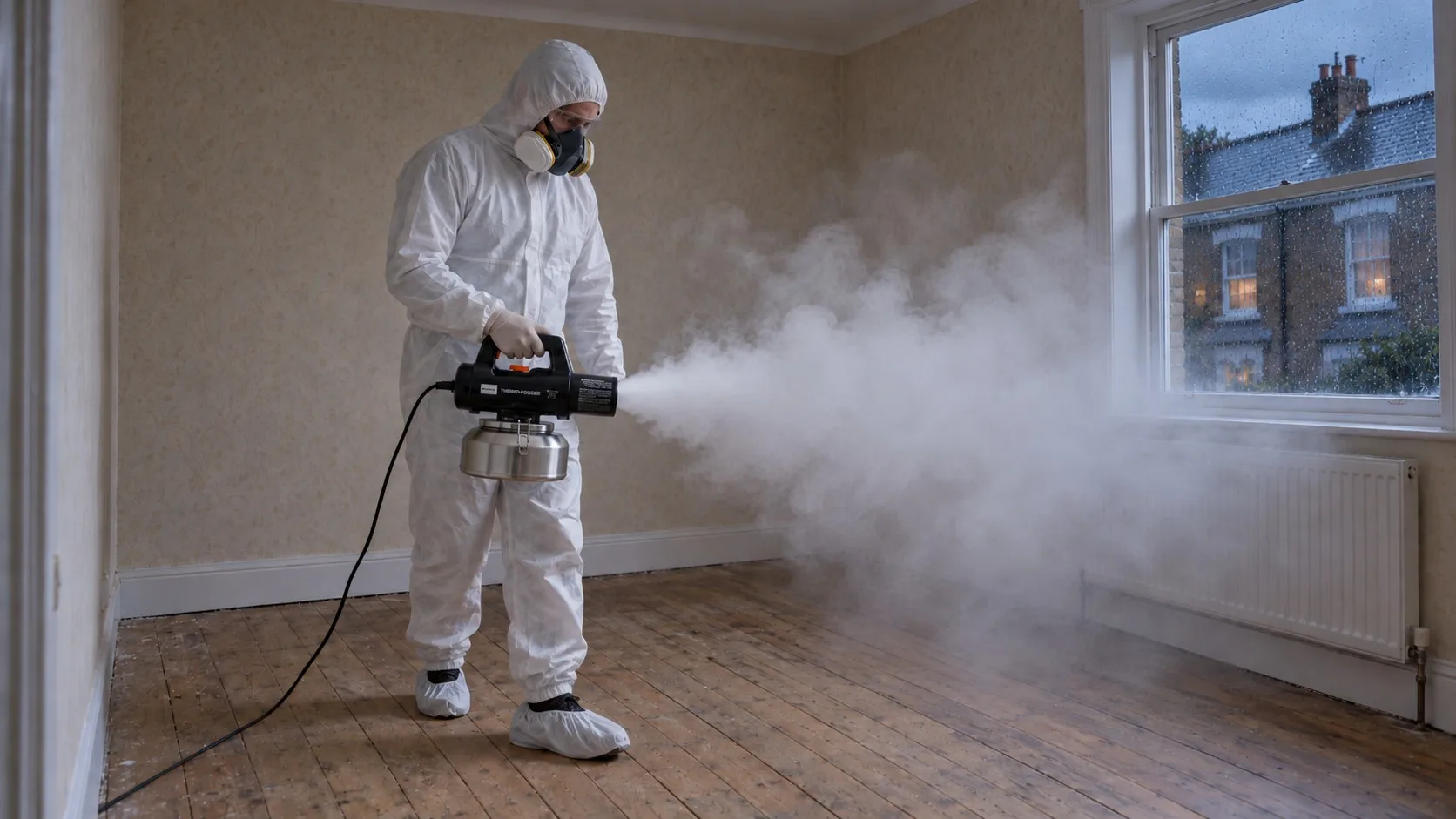
Wet fogging — sometimes called thermal fogging or ULV (ultra-low volume) fogging — uses a machine to atomise a liquid solution into very fine droplets that are then dispersed throughout a room or property. The droplet size is small enough to remain suspended in the air for a period before settling, allowing treatment of airborne contaminants as well as all surfaces within the space, including those that would not be reachable by hand.
The solution used depends on the purpose. For deodorisation, we use enzymatic or neutralising agents that react with and break down odour-causing compounds. For disinfection, we use professionally approved virucidal and bactericidal solutions capable of achieving the required kill rates.
The property must be vacant during the fogging process and for a defined period afterwards while droplets settle and the solution works. We advise on dwell time requirements before work begins.
How It Works in Practice
Our operatives seal windows and close internal doors to maximise concentration of the fog within the target area. The fogging machine is then operated to fill the space. Internal doors may be opened progressively to allow the fog to move through connected rooms, or individual rooms may be treated separately depending on the layout.
After the required dwell time, the property is ventilated thoroughly before re-entry by occupants. There is no significant residue left on surfaces after wet fogging — the droplets are fine enough that they do not leave pools or watermarks under normal operating conditions.
Wet fogging can be carried out as a standalone treatment or as a final stage following manual cleaning and decontamination, where it provides an additional layer of coverage across all surfaces simultaneously.
When Wet Fogging Is Used
- —Following biohazard cleaning, to provide full-surface disinfection as a final stage
- —Severe odour from decomposition, animal contamination or accumulated waste
- —Properties requiring decontamination before re-letting or occupation
- —Spaces where manual application of disinfectant to all surfaces would be impractical
- —Alongside manual sanitisation in hoarding and gross filth clearance, reaching areas that cannot be accessed by hand
- —Vehicles, lift shafts and enclosed spaces where access is limited
Wet Fogging vs Dry Fogging vs Ozone
Wet fogging is effective for treating airborne contamination and coating surfaces with deodorising or disinfectant solution. However, the droplets do not penetrate deeply into porous materials or into narrow voids and cavities.
Where odour or contamination has permeated into materials — for example, subfloor voids, wall cavities or saturated timber — our dry fogging service uses an ultra-fine vapour that reaches these areas more effectively.
For the most severe or entrenched odour, ozone treatment can be used to oxidise odour compounds at a molecular level. Each method has its appropriate application, and we will advise on which is most suitable for your situation.
Getting a Quote
Wet fogging can be booked as a standalone treatment or as part of a broader programme of specialist cleaning. The cost depends on the size of the property and the number of areas to be treated. Contact us with details of the property and we will provide a written quotation.